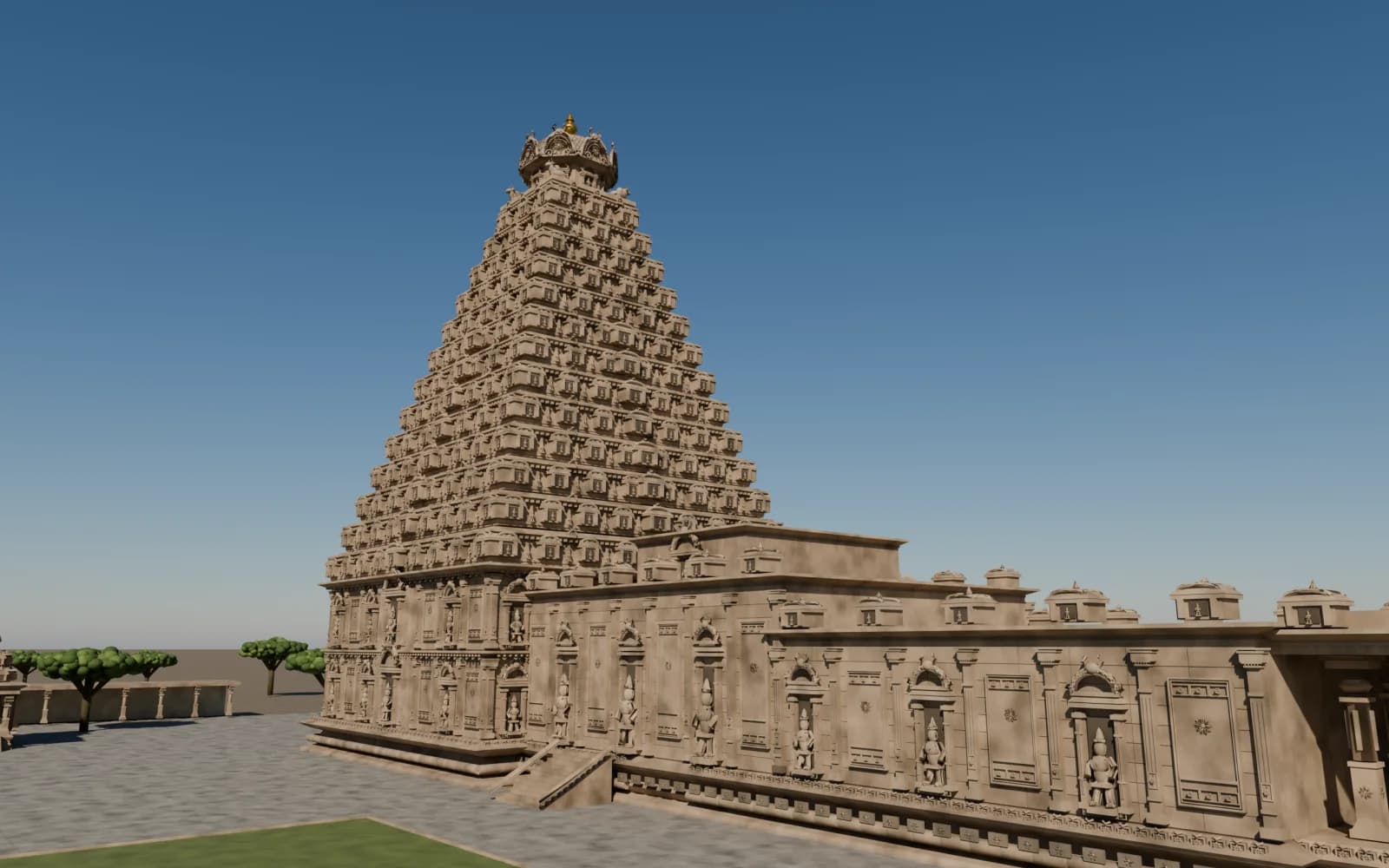
Start with the repetition.
The tower is organized into thirteen tiers. Instead of treating the building as a single mesh, the model uses repeated architectural elements: ledges, niches, columns, and a narrowing silhouette. Editable geometry makes it possible to revise the proportions without starting over.
This is a procedural reconstruction study. The useful artifact is both the image and the system of shapes behind it: cameras, materials, and geometry that can be changed and rendered again.
Architectural references
  → approximate proportions
  → repeated tier geometry
  → regional material masks
  → lighting, camera, render
Stone needs local variation.
The first detail pass introduced overly strong streaks. The revision used regional ledge masks to control runoff and weathering, with mineral variation and pitting adding smaller changes across the surface. This is procedural shading, not a physical weathering simulation.
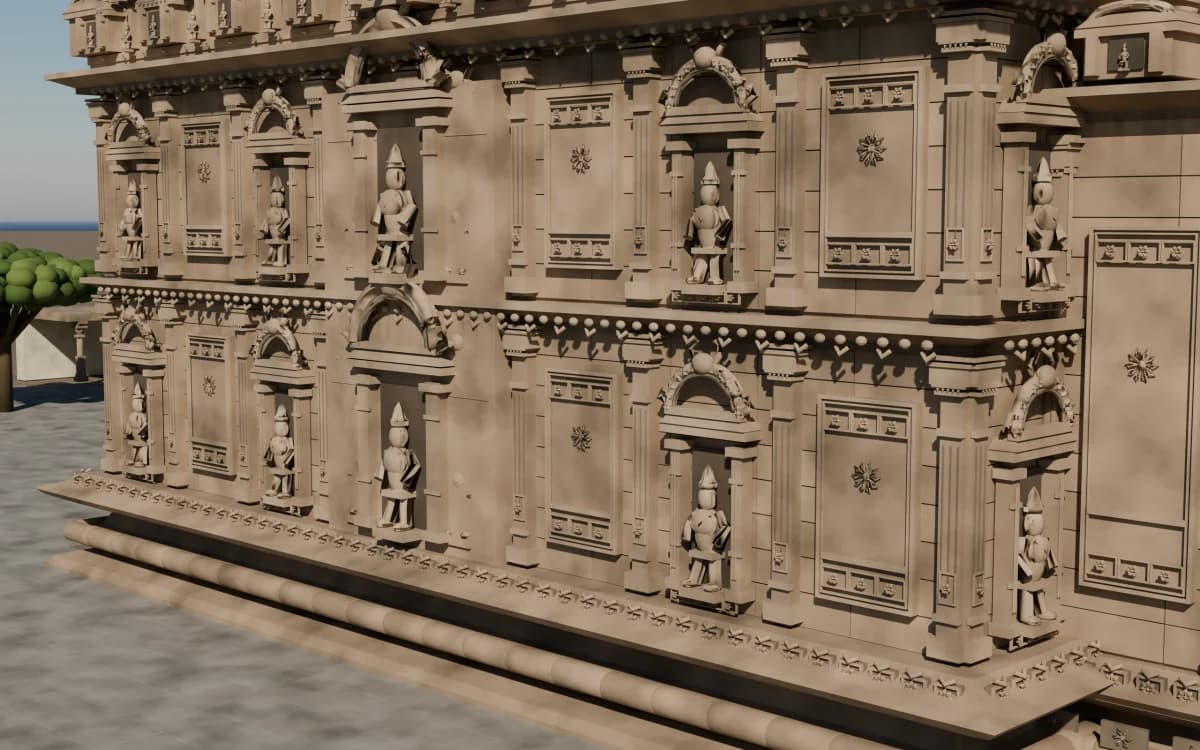
The point was to make detail follow the architecture. A global noise pattern can make every surface equally busy. Variation around ledges and carved recesses gives the material a more specific relationship to the building.
A study, with room to be wrong.
The proportions and motifs are approximate. Figures are stylized, and inscriptions are not reconstructed. This should be read as an interpretation of architectural form, not a measured survey or a historical record.
The published images are renders from the project’s own geometry. The revised hero also uses different render settings from the earlier version, so any visual improvement cannot be attributed to modeling alone. A useful next comparison would hold the camera, lighting, resolution, and sampling constant.